Filtration
Its microscopic porous structure can retain fine suspended particles in water, beverages, syrups and industrial liquids.

NATURAL MINERAL · POROUS SILICA · MULTIPLE APPLICATIONS
A lightweight, naturally occurring siliceous mineral formed from fossilised diatoms—valued for porosity, absorption, filtration and versatile industrial performance.
MATERIAL FOUNDATION
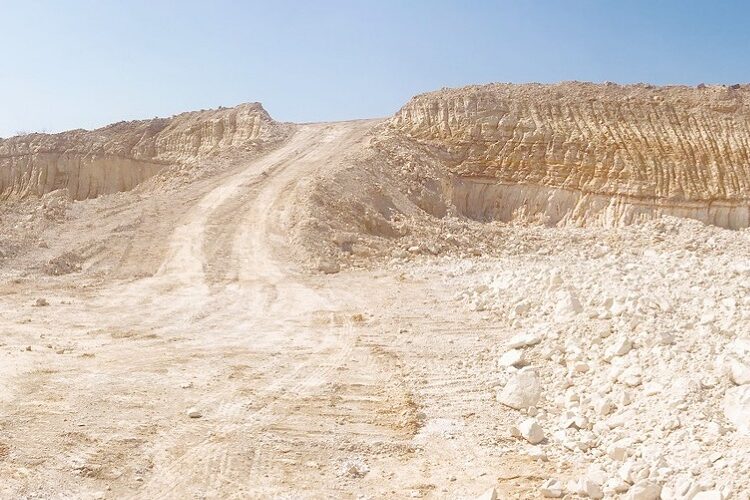
Diatomite is a soft sedimentary rock composed largely of the silica-rich shells of diatoms—single-celled algae found in fresh, brackish and marine waters. Long-term deposition creates a lightweight, porous mineral with high surface area.
Typical reference composition is approximately 80–90% silica, 2–4% alumina and 0.5–2% iron oxide. Actual chemistry varies with deposit, grade and processing route.
DEPOSIT & ANALYTICAL EVIDENCE
The images present an indicative deposit profile and laboratory results for a Lampang diatomite sample, supporting evaluation of chemistry, mineral phases and variation between deposit layers.
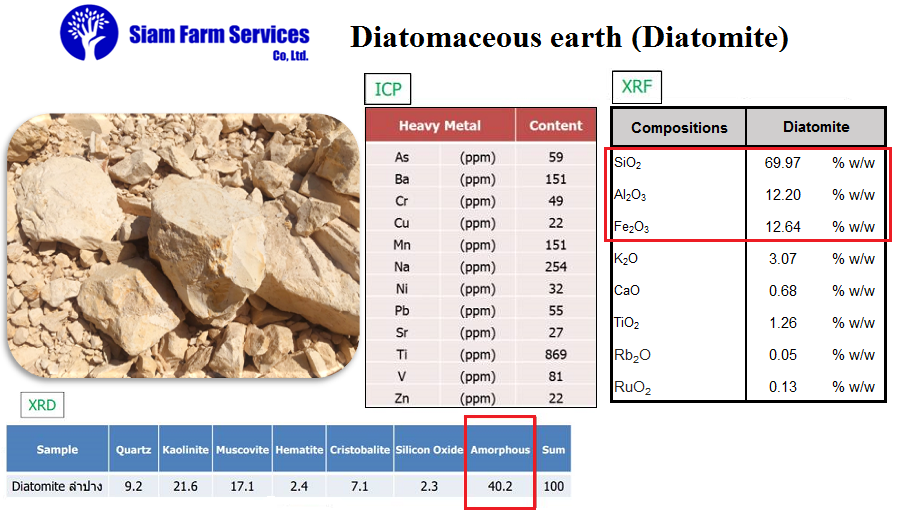
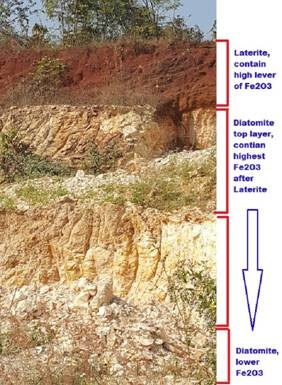
Note: These results describe a specific sample and sampling location; they are not universal specifications for all diatomite. Commercial qualification should include a sampling plan, documented test methods, detection limits and lot-by-lot verification.
GEOLOGY & FORMATION
Amorphous silica, or opal (SiO₂·nH₂O), from diatom cell walls accumulates in lake and marine basins. Preserved frustules create an extensive network of microscopic voids.
Many deposits are associated with Tertiary-to-Quaternary formations; some occur with volcanic ash. Each source therefore requires evaluation for chemistry, porosity, moisture, particle size and impurities.
APPLICATIONS
Grade selection and qualification should follow the intended use, product specification and applicable industry requirements.
Its microscopic porous structure can retain fine suspended particles in water, beverages, syrups and industrial liquids.
Silica-rich diatomite can be blended into cement raw materials to adjust silica content.
Low density, high surface area and porosity support liquid-spill control, moisture management and selected absorbent products.
A lightweight inert filler for selected paints, plastics, rubber, paper, ceramics, soaps and related manufactured products.
Fine silica particles can support controlled polishing applications such as metal polish and selected personal-care formulations.
Porosity helps retain water and nutrients while supporting aeration and drainage in horticultural growing media.
Dry diatomaceous earth is used in some physical pest-control applications; performance depends on grade, dryness and correct use.
It can serve as a carrier, anti-caking aid or moisture-management material in suitable agricultural formulations.
Its low thermal conductivity supports selected fire-resistant, insulation, acoustic and lightweight building products.
Suitable grades may be used as carriers, flow aids or functional mineral components subject to specification and regulatory review.
Natural, non-calcined material is used in some nutrition studies as a source of acid-insoluble ash for digestibility measurement.
RESPONSIBLE GRADE SELECTION
Natural, calcined and flux-calcined diatomite have different properties and should not be substituted without qualification—especially for food, feed, agriculture, cosmetics or worker-exposure applications.
SIAM FARM SERVICES · MINERAL APPLICATIONS